
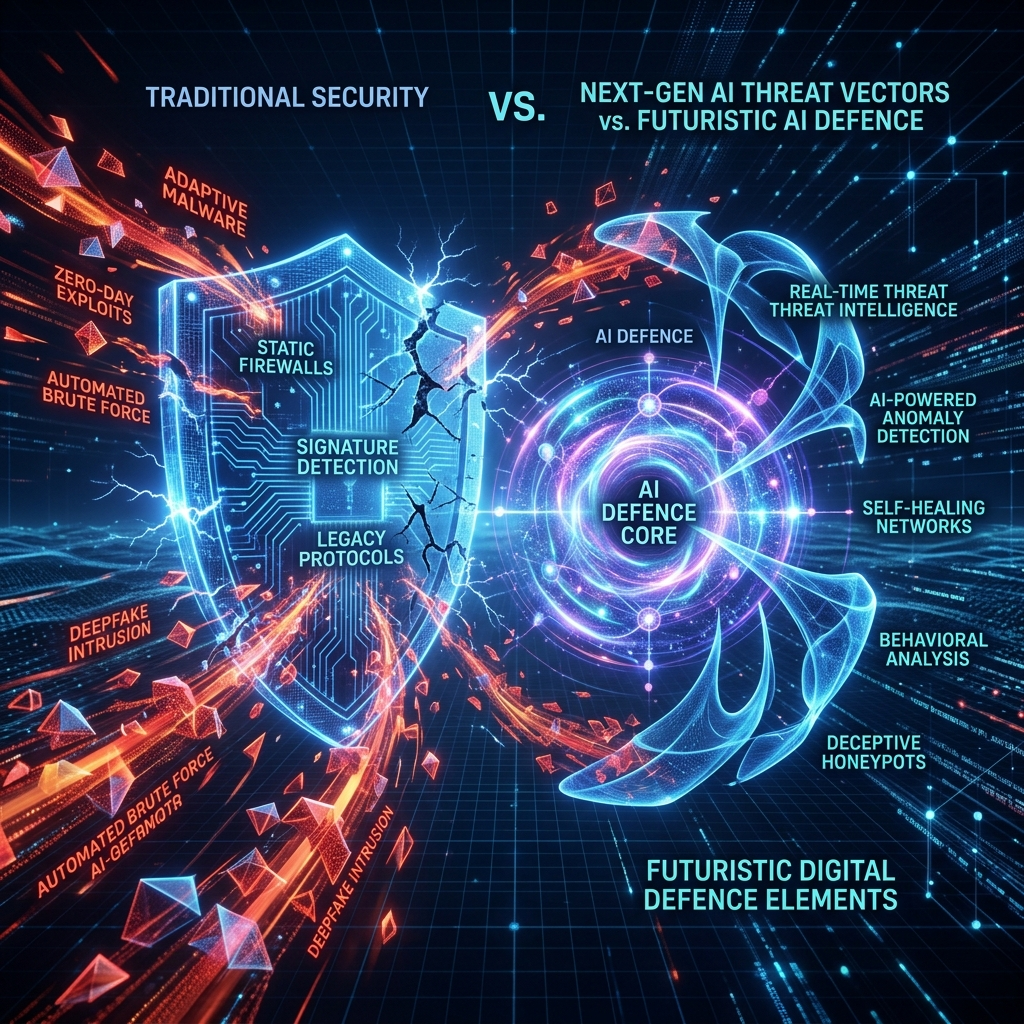

How AI Software Disruption Is Breaking Traditional Software Security Paradigms
AI software disruption is outpacing traditional security controls, exposing critical vulnerabilities across enterprise systems. A detailed analysis of AI software disruption impacting systems warns that static defenses fail to contain AI-driven exploits.
AI software disruption refers to the rapid integration of generative models and machine learning into core applications, altering the attack surface and redefining trust boundaries. Organizations now embed large language models for code suggestions, automated decision-making, and dynamic content generation, fundamentally shifting how software is built and operated. This shift amplifies AI cybersecurity threats, demanding that security teams contend with dynamic model behaviors and data-driven vulnerabilities rather than fixed code weaknesses, and reconsider assumptions around code provenance and integrity.
Emerging AI-specific security risks and vulnerabilities are already materializing. Adversarial attacks manipulate input data with subtle perturbations to force models into erroneous predictions or leaking sensitive information. According to Trinergy Digital’s software security essentials, prompt injection exploits the way large language models parse instructions, embedding malicious directives that override safeguards and exfiltrate data, while model poisoning introduces hidden backdoors at training time, and model inversion can reconstruct sensitive training data.
Traditional signature-based security tools rely on pattern matching and static heuristics, leaving them blind to novel AI-driven exploits. Since each adversarial payload or crafted prompt generates unique behavior, fixed rule sets cannot anticipate or flag these anomalies. Intrusion detection systems and web application firewalls, tuned for known malware signatures, frequently misclassify or ignore model-driven attacks. As a result, attackers can slip malicious requests past security gates, undermine data confidentiality, and maintain persistent access without triggering standard alerts.
Adaptive strategies for mitigation center on embedding security into the AI development lifecycle and beyond. Adopting AI DevSecOps fosters continuous integration of security, embedding automated code analysis, model validation, and real-time threat analysis throughout the CI/CD pipeline, as outlined in AI DevSecOps and application security. Leveraging AI-driven scanning tools can detect anomalous patterns in training data, while runtime monitoring platforms flag unusual API calls or inference behaviors, feeding back into development for rapid remediation.
Establishing robust governance frameworks is equally critical to counter AI cybersecurity threats at scale. According to the Gartner report on AI DevSecOps and the future of application security, organizations must codify policies for model evaluation, version control, and risk scoring, alongside defined accountability for AI outcomes. These frameworks should include regular audits, incident response playbooks tailored to model failures, and compliance checks for data provenance and bias mitigation, helping future-proof security systems against evolving AI risks.
Security teams face a profound evolution in responsibilities, shifting from perimeter defense to managing AI model lifecycles and data governance. Professionals must blend traditional cybersecurity expertise with machine learning literacy, understanding model training pipelines and potential exploit vectors. While AI-driven automation promises efficiency, it has also catalyzed workforce shifts, with recent projections highlighting AI-driven job cuts in repetitive tasks, forcing organizations to rethink roles and invest in strategic, high-value security functions.
Meeting these demands requires significant reskilling and new educational pathways. Industry partnerships and dedicated training programs at institutions such as Tufts University and other academic centers are expanding cybersecurity curricula to cover model governance, AI ethics, threat intelligence, and secure coding practices. Continuous professional development, including certifications in AI risk management and on-the-job rotations between data science and security teams, will be essential to build a resilient workforce.
As AI software disruption accelerates, legacy security paradigms will no longer suffice. Organizations that embrace adaptive, AI-infused cybersecurity architectures—integrating continuous monitoring, DevSecOps, and governance-driven risk management—can turn a disruptive challenge into a strategic advantage. Investing in model-aware defenses and workforce evolution not only mitigates emerging threats but also positions enterprises to harness AI safely and responsibly. In the AI era, security agility and forward-looking controls will be foundational to sustaining trust and resilience.