

How the Internet Broke Everyone’s Bullshit Detectors: The AI and Data Reality
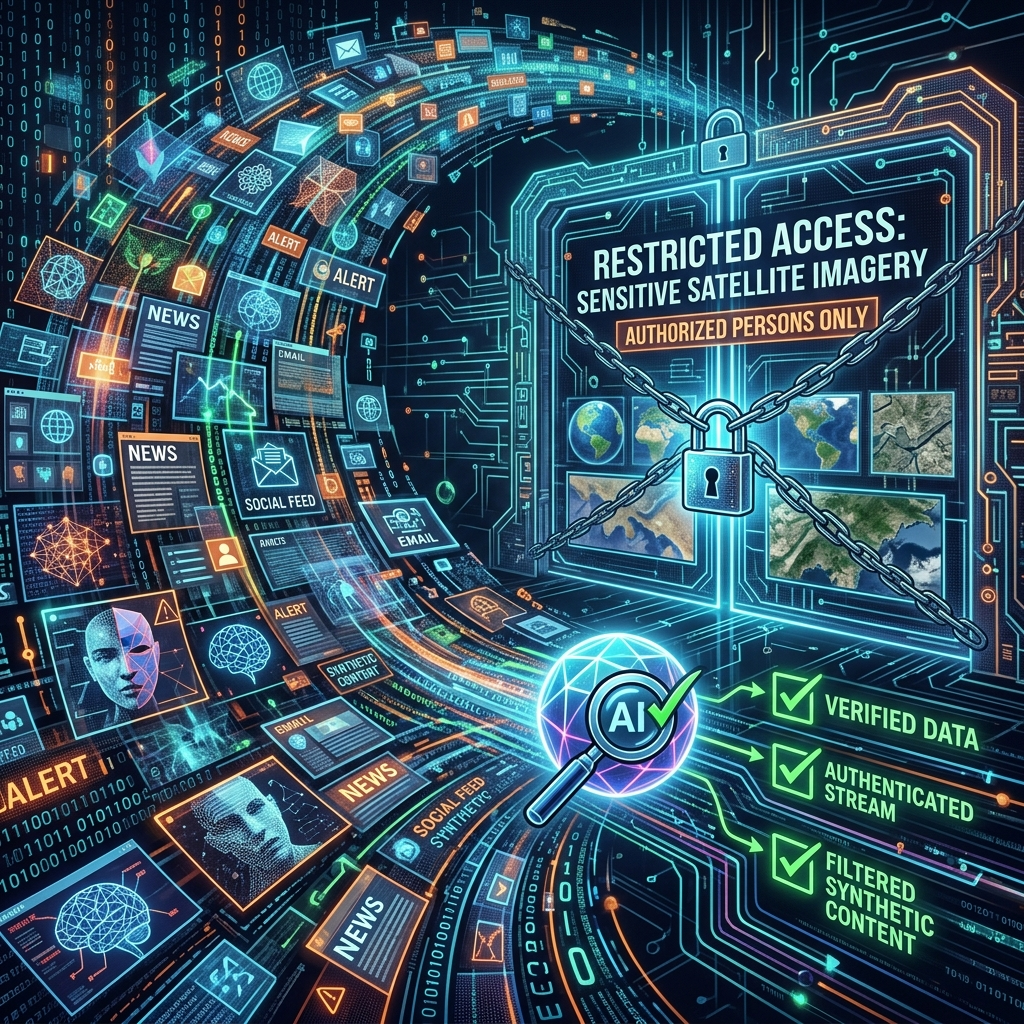
The internet broke everyone’s bullshit detectors, and the culprits are synthetic AI content floods and tightening geospatial data restrictions that make independent verification nearly impossible. What began as a democratization of information has devolved into a fog of deepfakes, fabricated imagery, and locked-down satellite feeds that leave even seasoned experts second-guessing reality. The result is a collective skepticism fatigue where people either believe everything or trust nothing at all.
AI-generated content now saturates every corner of the web, from convincing fake product reviews to entirely synthetic news stories that mimic journalistic credibility. The sheer volume overwhelms human capacity to fact-check, and traditional verification methods collapse under the weight of content that looks, sounds, and reads like the real thing. Large language models can generate thousands of plausible narratives in seconds, each tailored to exploit cognitive biases and emotional triggers.
This explosion creates what researchers call verification overload, where the cost of confirming authenticity exceeds the value of the information itself. Social media platforms struggle to flag misleading content faster than it spreads, and users grow numb to warning labels that appear on half the posts they encounter. Trust in digital media erodes not because people lack critical thinking skills, but because the baseline assumption that most content is genuine no longer holds.
Geospatial data access restrictions compound the problem by cutting off independent verification routes that once served as checks on official narratives. Governments and private companies increasingly limit satellite imagery, drone footage, and mapping data under national security or commercial pretexts. When a conflict zone image surfaces online, citizens and journalists cannot cross-reference it with freely available geospatial sources the way they could a decade ago.
Projects such as Wing’s drone delivery service highlight how commercial interests prioritize proprietary control over transparency, restricting public access to aerial data that could validate or debunk claims about infrastructure, environmental damage, or human rights abuses. The result is a verification bottleneck where only well-funded institutions retain the tools to separate truth from fabrication, leaving ordinary users in the dark.
Emerging agentic AI verification models offer a potential counterbalance by functioning as autonomous fact-checkers that parse metadata, trace content provenance, and cross-reference claims against verified databases in real time. These systems operate continuously without human fatigue, identifying synthetic artifacts in images, analyzing linguistic patterns that betray machine authorship, and flagging inconsistencies across multiple sources. AI-driven search technology is evolving to integrate these verification layers directly into information retrieval, so users receive trust scores alongside search results.
Google’s Antigravity project exemplifies this shift, deploying machine learning models that assess content authenticity before it reaches end users. The initiative uses multimodal analysis to detect manipulated videos, altered photos, and text generated by language models, then surfaces verified alternatives when available. While still experimental, Antigravity represents a blueprint for embedding verification into the infrastructure of the internet itself rather than treating it as an afterthought.
Yet technology alone cannot restore functional bullshit detectors without parallel investments in digital literacy and human oversight. Automated systems make errors, inherit biases from training data, and can be gamed by adversarial actors who reverse-engineer detection algorithms. Users need foundational skills to interpret verification signals, understand probabilistic confidence scores, and recognize when to seek expert judgment rather than defer entirely to algorithmic verdicts.
Educational initiatives must emphasize media literacy as a core competency, teaching people to trace information back to primary sources, assess the credibility of publishers, and identify hallmarks of synthetic content such as unnatural lighting in images or repetitive phrasing in text. AI software disruption impacting systems across industries underscores the urgency, as misinformation spreads faster in sectors from healthcare to finance where stakes are highest.
Ethical AI governance frameworks are equally critical to prevent verification tools from becoming instruments of censorship or state control. Models trained to flag misinformation can just as easily suppress dissent or amplify official propaganda if designed without transparency and accountability safeguards. Independent audits, open-source verification code, and diverse stakeholder input must shape how these systems define truth and allocate credibility.
Cross-sector collaboration offers the most viable path forward, uniting tech platforms, newsrooms, academic institutions, and civil society organizations around shared standards for content authenticity and data access. Industry consortia are developing cryptographic watermarking protocols that embed origin metadata into digital files at creation, making tampering detectable downstream. Journalists and researchers are pooling resources to maintain public geospatial databases that fill gaps left by commercial restrictions.
These collaborative frameworks also address workforce displacement concerns, as AI-driven job cuts by 2026 threaten roles in content moderation and fact-checking. Reskilling programs can transition displaced workers into oversight positions that monitor algorithmic performance, adjudicate edge cases, and maintain the human judgment layer essential for nuanced verification decisions.
Rebuilding trust in digital information requires a multipronged strategy that marries autonomous verification technologies with robust digital literacy programs and transparent governance structures. The internet broke everyone’s bullshit detectors through an unprecedented combination of synthetic content proliferation and restricted access to verification tools, but the same technologies driving the crisis also hold the keys to recovery. Success depends on treating verification not as a technical problem to be solved in isolation, but as a sociotechnical challenge demanding coordinated action across institutions, disciplines, and borders. Only by integrating intelligent systems with educated users and accountable oversight can we restore the ability to distinguish signal from noise in an increasingly synthetic information landscape.