
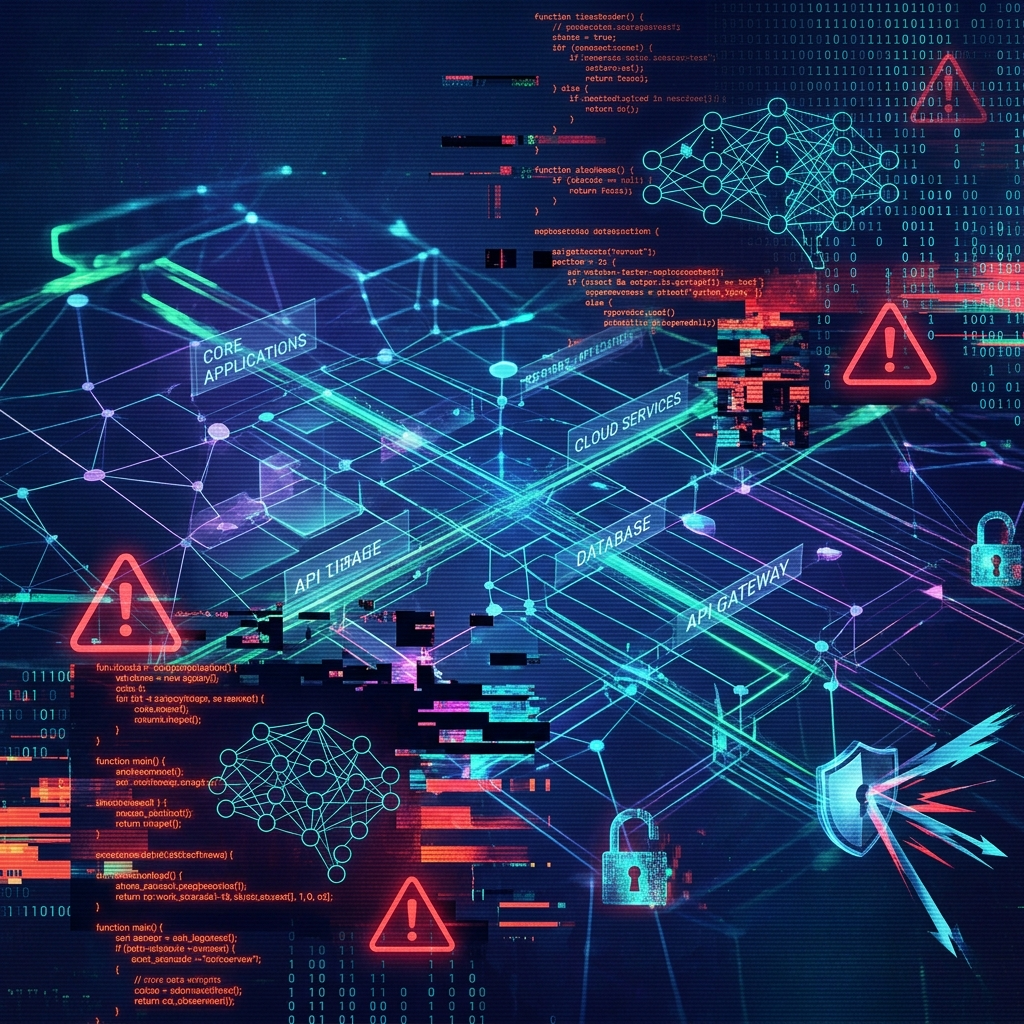

How AI Software Disruption Is Breaking Traditional Software Security Paradigms
AI software disruption is forcing legacy security teams to abandon signature-based defenses for dynamic approaches. A 40% surge in AI-driven vulnerabilities in 2025 underscores the urgency of adopting adaptive strategies.
AI software disruption encompasses generative AI, adversarial machine learning, and automated coding tools that reshape software development lifecycles and expose novel threat vectors. Generative AI can produce entire modules with minimal oversight, while adversarial models can be manipulated to yield incorrect outputs. Recent assessments show these forces permeate industries such as healthcare and finance, where platform updates impact patient data and financial transactions analysis of AI software disruption impacting systems. This shift demands a reevaluation of traditional security metrics.
Developers increasingly rely on AI-generated code, which may embed subtle logic flaws or insecure default settings that evade static scanners. Models trained on public repositories can inherit vulnerabilities, while adversarial inputs—designed to manipulate model predictions—can flip authentication workflows. Prompt injection attacks inject malicious instructions into model prompts, hijacking generation pipelines, and supply chain tampering inserts compromised dependencies at scale. Industries such as manufacturing and retail are already reporting spikes in untested AI components. Security frameworks emphasize threat modeling and continuous monitoring software security essentials and vulnerabilities to close these gaps.
In early 2025, researchers exploited prompt-engineered payloads to bypass authentication checks in leading AI code generators, exposing sensitive API keys. One NBC News investigation found that code produced by Claude and ChatGPT defaulted to deprecated cryptographic libraries, enabling unauthorized data access in test environments AI code vulnerabilities in flagship models. At the RSA Conference, Gartner analyst Dr. Maya Singh warned that many organizations lack adequate auditing of AI pipelines, allowing adversarial attacks to remain undetected for months. This underscores the hidden risks lurking in automated workflows.
Major tech firms are also grappling with AI-driven changes to their search infrastructure. Google’s integration of generative responses has introduced novel threat vectors in query parsing and response caching analysis of Google disruption impacting systems. Security architects now must reevaluate input sanitization, strengthen endpoint validation, and monitor model drift to prevent exploitation of dynamic content streams.
Security teams are adopting multilayered defenses that combine static code analysis with AI-driven anomaly detection and runtime security telemetry. Automated fuzzing engines generate millions of test cases to uncover edge-case failures, while behavior analytics flag deviations from established baselines. Container isolation and strict dependency whitelisting further harden deployment environments. Regular red teaming exercises and close collaboration between development and security operations accelerate vulnerability discovery. As outlined in a Gartner-backed report, integrating AI into DevSecOps pipelines can catch emergent threats before release AI DevSecOps and application security.
Beyond technical controls, organizations must implement robust governance frameworks that oversee AI usage, from model sourcing through deployment. Cross-functional risk committees should validate model provenance, audit AI-generated code, and enforce version control to track changes. Real-time logging and transparency measures ensure accountability in algorithmic decisions, reducing the risk of unchecked or biased outputs insights on governance in AI-driven search technology. These policies create a structural defense against emerging AI-driven threats.
AI software disruption is also reshaping workforce dynamics, as automation and generative tools replace routine coding and analysis tasks. Companies across software development, cybersecurity, and IT support have announced workforce reductions tied to these efficiencies analysis of AI-driven job cuts in 2026. This leaner staffing model intensifies the burden on security teams, demanding scalable monitoring solutions and upskilling programs to bridge expertise gaps.
As AI software disruption accelerates, security must pivot from static defenses toward adaptive, intelligence-driven strategies. Embracing AI for threat detection, while instituting rigorous controls against adversarial manipulation, will be essential. Organizations that balance innovation with governance and continuous learning can safeguard next-generation software systems and maintain resilience in an era defined by rapid AI-driven transformation.