
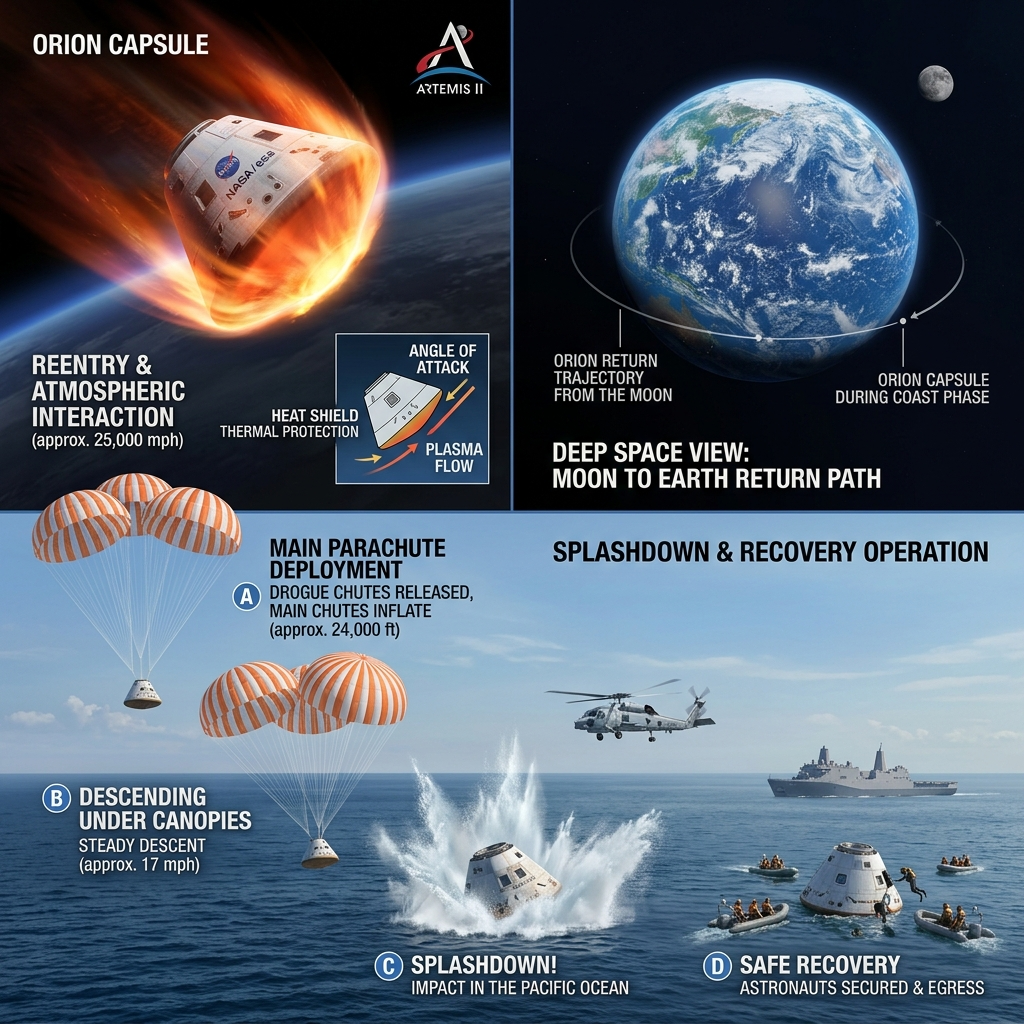

Artemis II Astronauts Return Safely to Earth After Historic Flight Around the Moon
Artemis II astronauts return safely to Earth after completing a historic 10-day journey around the Moon. The mission marks a significant milestone in human space exploration, extending the farthest distance travelled from our planet in over half a century and showcasing critical advances for future lunar and Mars missions.
The crew—Commander Reid Wiseman, Pilot Victor Glover, Mission Specialist Christina Hammock Koch, and Canadian astronaut Jeremy Hansen—traversed over 695,000 miles in NASA’s Orion spacecraft, breaking records for the farthest human spaceflight since Apollo 13. Launched on the Space Launch System (SLS) rocket, they executed translunar injection (the burn that propels the spacecraft from Earth orbit toward the Moon), mid-course corrections, and a free-return trajectory designed to loop the craft around the lunar sphere and back to Earth. NASA officials note that these manoeuvres, detailed at NASA’s Artemis II mission page, are vital rehearsals for upcoming crewed landings.
Re-entering Earth’s atmosphere at nearly 25,000 miles per hour, the Orion capsule’s heat shield, constructed from AVCOAT ablator material, endured temperatures exceeding 5,000 °F while preventing plasma erosion. A precise three-phase parachute deployment—pilot, drogue, and main canopies—slowed the capsule to under 20 mph for a controlled splashdown in the Pacific Ocean. The capsule’s onboard guidance computer integrated AI-driven search technology, originally developed for complex data retrieval applications, to optimize its re-entry trajectory in real time. Engineers monitored thermal sensors throughout the descent, validating new materials that will be critical for crewed Mars entry systems.

Beyond the hardware, astronauts conveyed the emotional weight of their voyage. They described the view of Earth as a transformative perspective shift.
“Seeing our planet shrink to a luminous marble against the blackness of space was life-altering and deeply humbling,” said Commander Reid Wiseman.
Mission Specialist Christina Hammock Koch and Pilot Victor Glover both remarked that viewing Earth as a fragile ‘blue marble’ reinforced their commitment to environmental stewardship and a shared sense of global unity. They spoke about how this perspective resonated deeply during post-mission public engagements.
“Holding that image in my mind motivates me to pursue every technological advance that can protect this world,” said Christina Hammock Koch.
These reflections underscore the mission’s human dimension and its power to unite observers on Earth. They illustrate how space exploration continues to connect diverse communities through shared wonder.
During the closest lunar approach, crew high-resolution cameras captured over 15 previously undocumented craters on the Moon’s far side, including ones tentatively named after pioneering women and Indigenous figures. Instruments measured solar particle flux and magnetic field variations, revealing transient anomalies near local ridges. Geospatial mapping of potential ice deposits in permanently shadowed regions advances resource identification vital for sustained lunar presence. Additional data on meteorite impact rates and radiation flux detailed in Wired’s Artemis II coverage, will directly inform landing site decisions for Artemis III.
Building on Artemis II’s success, NASA has outlined Artemis III to land astronauts near the Moon’s south pole by 2025 or later, targeting regions with water-ice reserves. Engineers plan to expand AI roles in system diagnostics, autonomous docking, and environmental control, bolstering mission resilience. These advances, explored in AI software disruption impacting mission-critical systems, aim to reduce crew workload and accelerate response to in-flight anomalies.
International partnerships, exemplified by Canada’s history-making inclusion of Jeremy Hansen and contributions from the European Space Agency and Japan’s JAXA, are shaping a collaborative lunar economy. As AI assumes more operational tasks—from habitat life support adjustments to predictive equipment maintenance—space agencies are evaluating human resource models. Debates around AI-driven job cuts and role redefinitions underscore the need to balance automation with human oversight in extended missions.
The safe return of Artemis II astronauts symbolizes humanity’s renewed commitment to space exploration, blending cutting-edge technology with profound human experiences. As lessons from this mission feed into strategies for sustainable lunar habitats and future Mars voyages, Artemis II stands as a testament to innovation, cooperation, and the enduring spirit of discovery. By bridging scientific ambition with human curiosity, the voyage sets a new precedent for international and technological collaboration beyond Earth’s orbit.